Avatar Embodiment Manipulation
VR Embodiment experiment preview.
Project Description and Goal
This project was part of my PhD thesis. The goal was to study the sense of embodiment (the feeling that an avatar is our real body) in VR. The full implementation was done by myself, in Unity, using the Oculus SDK. The experiment was co-designed with my PhD supervisors Jean-Marie Normand, Camille Jeunet-Kelway and Guillaume Moreau.
The experiment was conducted on 47 participants, and the results were published and presented at the ICAT-EGVE 2022 conference. The paper can be found here.
Experiment Short Description
In this experiment, participants had to perform 3 different right-hand movements in VR. To do so, they were embodied in an avatar, and had to perform the movements with their real hand. The Oculus Quest 2 tracking was used to track the participant's real hand, and in the VR headset, the participant could see the avatar performing the same movement. Only the right hand was tracked, while upper body and head moved using inverse kinematics.
In half of the trials, the avatar's hand was moving according to the participant's hand movement. In the other half, we introduced a biased visual feedback to the avatar's hand to impact user's embodiment. There were in total 12 different bias conditions (details in the paper).
Screenshots
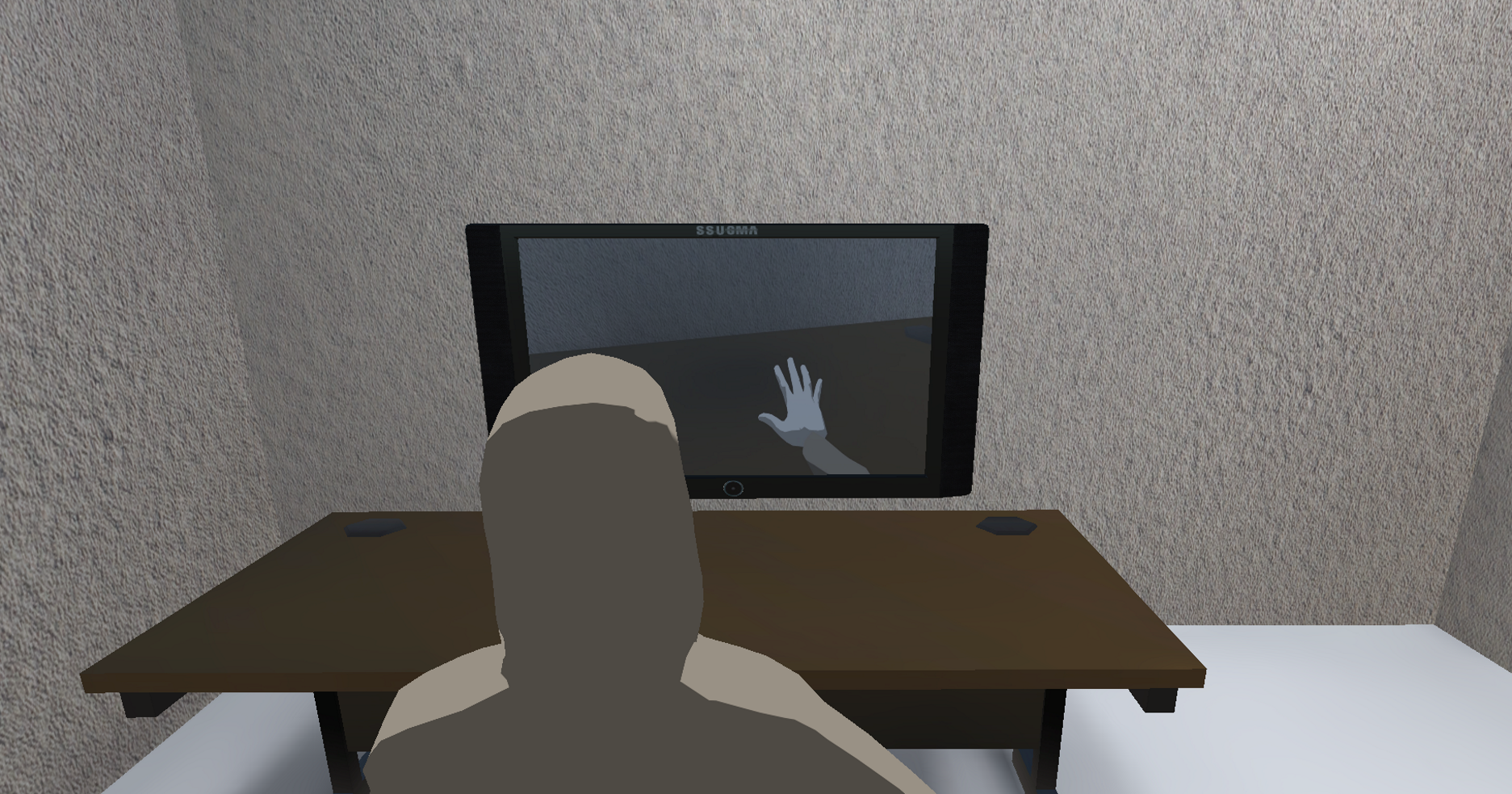 Overview of the scene. The participant is embodied in the avatar, and can see the avatar's hand moving according to his own hand movement. Instructions were displayed on a virtual TV.
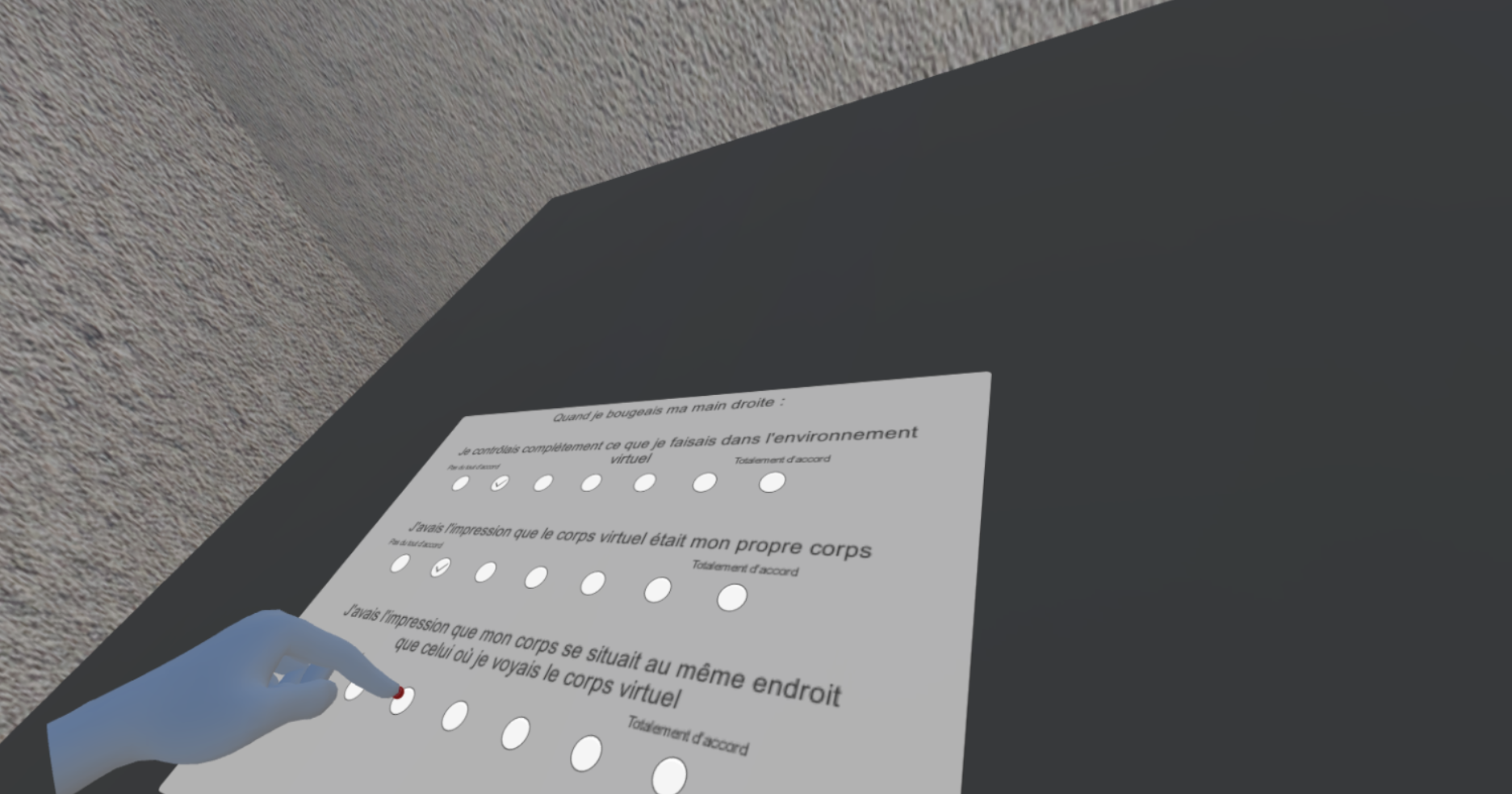 Questionnaire filled by participants during the experiment to measure their sense of embodiment.
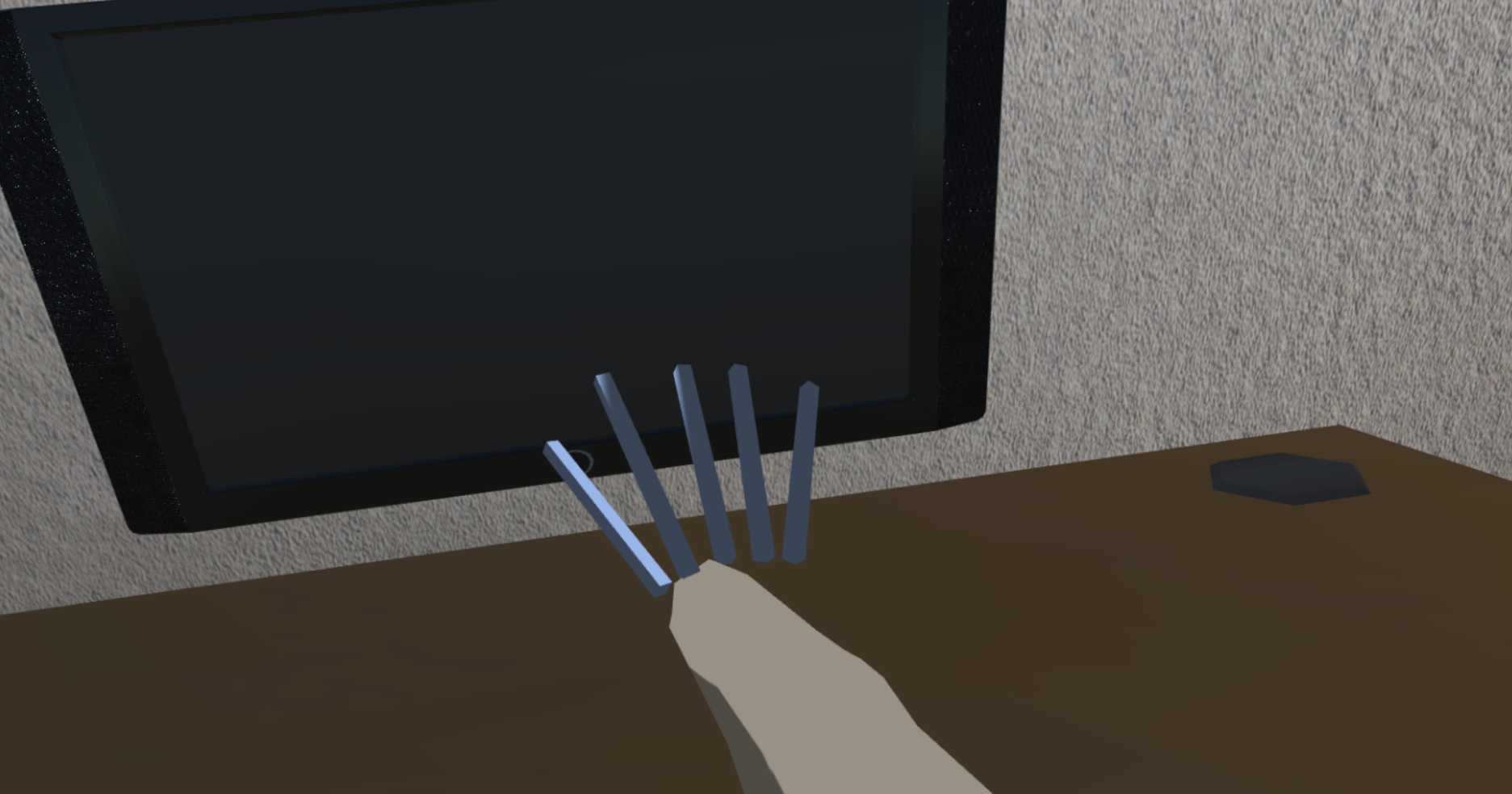 Avatar with a stick-finger hand, to reduce the participant's body ownership toward the avatar.